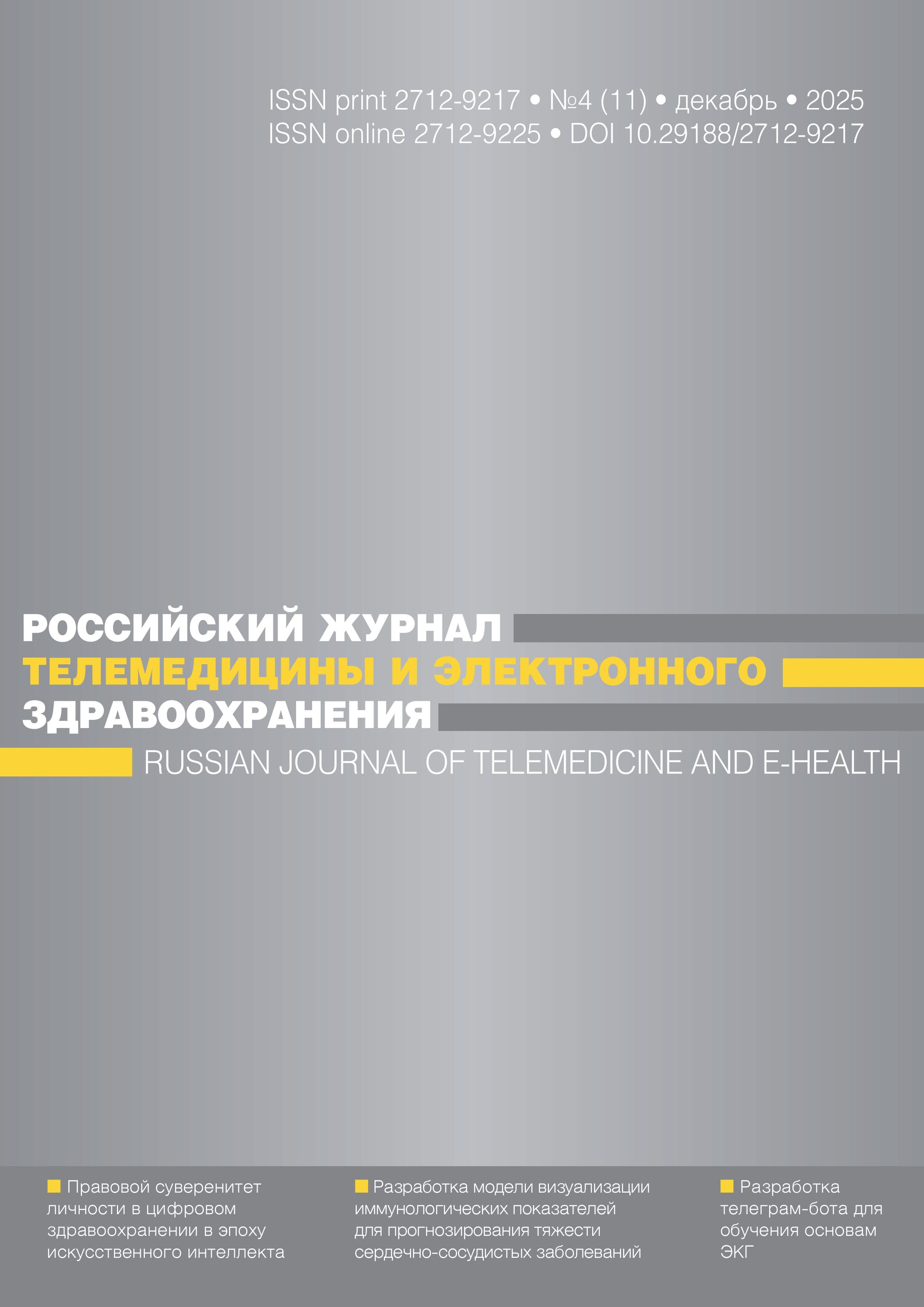
Number №4, 2025
Legal Sovereignty of the Individual in Digital Healthcare in the Era of Artificial Intelligence
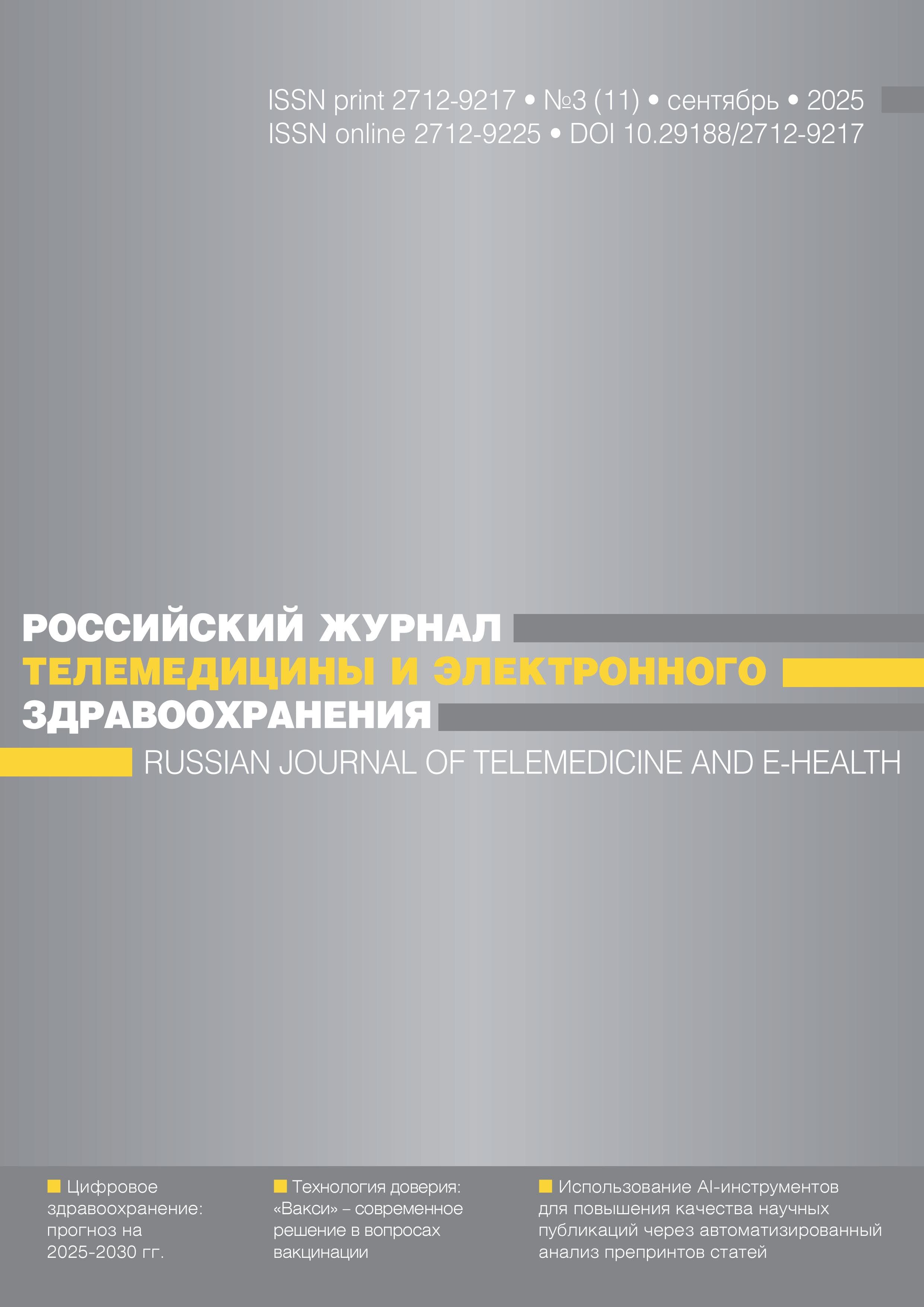
Number №3, 2025
Digital Health: Forecast for 2025-2030
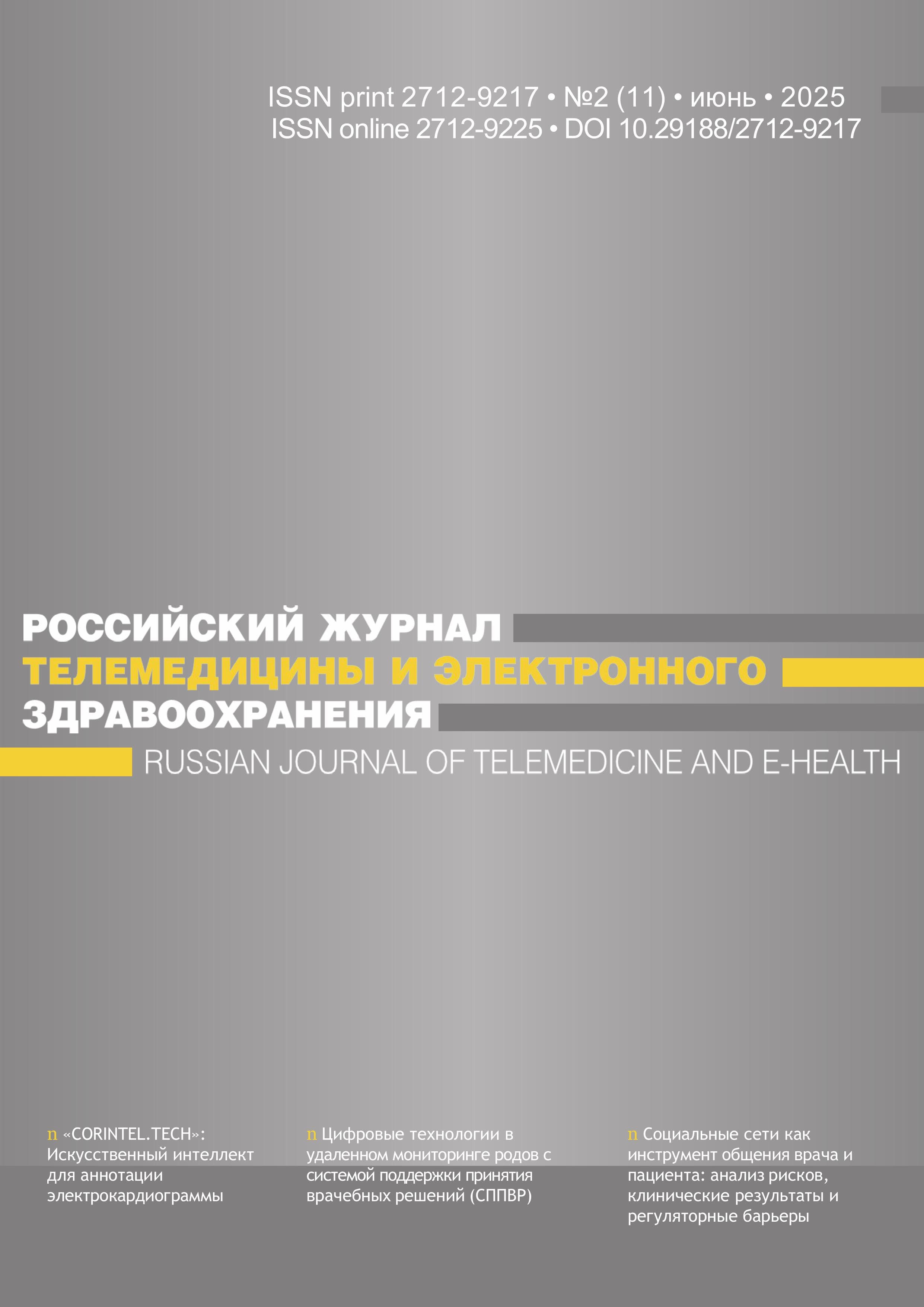
Number №2, 2025
Digital technologies in remote monitoring of childbirth with a Clinical decision support system (CDSS)
Number №1, 2025
Digital technologies for health promotion and disease prevention in older adults
Number №4, 2024
Computer reconstruction of the interaction of genes associated with Angelman syndrome
Number №3, 2024
Telemedicine today: trends in the use of telemedicine consultations based on regional experience
Number №2, 2024
Mobile apps for psychological well-being: user attitudes and definition of requirements
Number №1, 2024
Diagnosis in the era of digital medicine
Number №4, 2023
Artificial intelligence in Russian healthcare: collecting and preparing data for machine learning
Number №3, 2023
China as a supplier of medical equipment in the Russian Federation. Options for cooperation and features of working with Chinese suppliers
Number №2, 2023
Experience in teaching telemedicine in the system of higher professional education The attitude of medical workers to telemedicine technologies
Number №4, 2022
Physician burnout: the hidden healthcare crisis. Results of an online survey of doctors
Number №3, 2022
Interaction of clinical and diagnostic medicine. Results of an online survey of doctors
Number №2, 2022
Mobile applications for mental health self-management: a review of customers’ opinions Ultrasound robots: ready-to-use solutions and perspective directions
Number №1, 2022
Digital transformation of the pathological service as a way to improve the quality of medical care
Number №4, 2021
Clinical guidelines of the Ministry of Health of the Russian Federation: are doctors ready to follow them? Results of an online survey of doctors.
Number №3, 2021
Виртуальная реальность (VR) в клинической медицине: международный и российский опыт
Number №2, 2021
Дистанционные консультации пациентов: что изменилось за 20 лет?
Number №1, 2021
Experience of participation in the blood pressure telemonitoring pilot project of the Ministry of Healthcare
Number №4, 2020
Автоматизация процесса выявления у беременных заболевания COVID-19
Number №3, 2020
Remote cognitive behavioral therapy for stress disorder associated with the COVID-19 pandemic
Number №2, 2020
Distance education at a medical school during the COVID-19 pandemic: the first experience through the eyes of students
Number №1-2, 2018
Ответственность при использовании телемедицины: врач или юрист Скрининг меланомы: искусственный интеллект, mHealth и теледерматология
Number №3, 2018 год
II Всероссийский форум по телемедицине, цифровизации здравоохранения и медицинскому маркетингу «ТЕЛЕМЕДФОРУМ 2019» Эффективность телемедицинских консультаций «пациент-врач» Телереабилитация: рандомизированное исследование исходов
Number №1-2, 2019
Роль искусственного интеллекта в медицине Информационная система поддержки принятия врачебных решений
Number №1, 2020
Technologies for continuous monitoring of blood pressure: prospects for practical application Telemedicine technologies in the Chinese army
Number №2, 2017
Primary telemedicine consultation "patient-doctor": first systematization of methodology
Number №1, 2017
1. A systematic review of using Internet messengers in telemedicine 2. Telemedicine and social networks in the fight against drug addiction
Number №1, 2016
1. The Experience of the Telehealth Network of Minas Gerais, Brazil 2. The Remote Monitoring of Patients with Congestive Heart Failure:The Organizational Impact..
Number №1, 2015
Teleassessment for diagnosis and treatment in urology Efficiency of telemedicine at the northern regions Russian Federation A.L. Tsaregorodtsev

Is it possible to make a diagnosis remotely?

Number №1, 2022 - page 69-79
DOI: 10.29188/2712-9217-2022-8-1-69-79
For citation: Shaderkin I.A. Is it possible to make a diagnosis remotely? Russian Journal of Telemedicine and E-Health 2022;8(1)69-79; <a href="http://doi.org/10.29188/2712-9217-2022-8-1-69-79">https://doi.org/10.29188/2712-9217-2022-8-1-69-79</a>
Shaderkin I.A.
Information about authors:
16034
Download PDF

Limitations for making diagnosis remotely which are contained in the Federal Law “On the fundamentals of public healthcare in Russian Federation” from 21.11.2011 N 323-ФЗ and entered into force on the 1st of January 2018, lead to great discussions in the professional society.

In this article we describe hypothetical outcomes of remote diagnostic such as increasing of online consultations and as its consequence – increase in financial expenses, health facilities burden, participance of business representatives and decreased quality of medical care in connection to all of them.

Situation is worsened due to the lack of real experience on applying telemedical technologies in clinical practice.

The term «diagnosis» is not established in the Federal Law 323 «On the fundamentals of public healthcare in Russian Federation» which also worsens the prohibition of remote diagnosis.

In this paper the examples of changing approaches from nosological method of patient management to a syndromal one are described. Attention is paid to an international experience of this method, its effectiveness and logic, and exceptions to the rule such as development of telemedical centers in Moscow in the period of COVID-19 pandemic that allowed to not only make a diagnosis remotely and prescribe treatment but also make a list of temporary incapacity for work.

Technological development and appearance of new knowledges not only change diseases classification but also provide new possibilities for receiving objective information of patient health. Medical devices develop and improve becoming more compact and intuitive, available in price for wide range of people including persons without medical education. Now it’s possible for patients to make laboratory studies which previously were available only in clinics, by themselves at home and transfer data to any distance with applying of telemedicine technologies. Nevertheless, patients still need available medical care.

Existing legislative limitations for remote diagnosis and treatment prescribing, which are established in the Federal Law 323, don’t allow to approach flexibly for new changing conditions and implement potential opportunities for people but all this possibilities are contained in one of the most powerful cross-cutting technologies – telemedicine.

Attachment Size
Download 478.37 KB
Keywords: diagnosis; remote technologies; telemedicine; law